
Root Canal Treatment Is Not as Scary as You Think   For many people, hearing the words “root canal” immediately causes anxiety. Movies, television, and old stories from decades ago have given root canal treatment an unfair reputation as

Comment

Root Canal Treatment Is Not as Scary as You Think

For many people, hearing the words “root canal” immediately causes anxiety. Movies, television, and old stories from decades ago have given root canal treatment an unfair reputation as a painful and terrifying dental procedure. The truth is, modern root canal therapy is designed to relieve pain — not cause it.

If your dentist or endodontist has recommended a root canal, understanding what the procedure actually involves can help ease your fears and give you confidence moving forward.

What Is a Root Canal?

A root canal is a procedure used to save a tooth when the inside tissue, called the pulp, becomes infected or inflamed. This can happen because of:

  • Deep decay

  • Cracks or fractures

  • Trauma to the tooth

  • Large fillings or repeated dental work

During treatment, the infected tissue is carefully removed, the inside of the tooth is cleaned and disinfected, and the tooth is sealed to prevent future infection.

The goal is simple: eliminate pain, remove infection, and save your natural tooth.

Root Canals Relieve Pain

One of the biggest misconceptions about root canals is that they are extremely painful. In reality, most patients say the procedure feels very similar to getting a routine filling.

Thanks to modern anesthetics, advanced technology, and specialized training, patients are kept comfortable throughout treatment. In fact, people are often surprised by how easy the experience actually is.

Most of the pain people associate with root canals comes from the infection itself — not the treatment. The procedure is what stops the toothache.

Modern Technology Has Changed Everything

Dentistry has advanced tremendously over the years. Today’s endodontic procedures use tools and techniques that make treatment faster, more precise, and more comfortable than ever before.

Modern root canal treatment may include:

  • Digital imaging

  • 3D CBCT scans

  • Dental microscopes

  • Rotary instrumentation

  • Improved anesthetic techniques

These advancements allow endodontists to diagnose problems accurately and treat teeth efficiently while maximizing patient comfort.

Why Saving Your Natural Tooth Matters

Whenever possible, saving your natural tooth is usually the best option for your long-term oral health.

Keeping your natural tooth helps:

  • Maintain normal chewing function

  • Preserve your natural bite

  • Prevent neighboring teeth from shifting

  • Avoid more costly procedures like implants or bridges

A properly treated and restored tooth can often last many years — even a lifetime.

What to Expect After Treatment

Most patients return to normal activities the same day or the next day after a root canal. Some mild soreness is normal for a few days, but this is usually manageable with over-the-counter medications.

After treatment, your dentist will typically place a permanent restoration, such as a crown, to protect the tooth and restore full function.

Don’t Let Fear Delay Treatment

Ignoring an infected tooth will not make the problem go away. Infections can worsen over time, leading to increased pain, swelling, and even tooth loss.

If you’ve been told you need a root canal, the best thing you can do is address the problem early. Modern root canal therapy is predictable, effective, and far more comfortable than most people expect.

The Bottom Line

Root canal treatment has come a long way. What was once feared is now a routine procedure focused on relieving pain and saving teeth comfortably and efficiently.

If you’re nervous about treatment, talk openly with your dentist or endodontist. Understanding the process and knowing what to expect can make all the difference.

A root canal is not something to fear — it’s often the solution that gets you out of pain and back to smiling comfortably again.

Comment


    Why CBCT 3D Imaging Is Invaluable in Endodontics   Modern endodontics has evolved far beyond traditional X-rays. One of the most important advancements is  CBCT (Cone Beam Computed Tomography) 3D imaging —a technology that has fundamenta

Comment

Why CBCT 3D Imaging Is Invaluable in Endodontics

Modern endodontics has evolved far beyond traditional X-rays. One of the most important advancements is CBCT (Cone Beam Computed Tomography) 3D imaging—a technology that has fundamentally changed how endodontists diagnose and treat dental conditions.

If you’ve ever been told you need a CBCT scan, you might wonder why. The answer is simple: it allows us to see what traditional imaging simply cannot.

What Is CBCT Imaging?

CBCT is a specialized type of 3D imaging that captures detailed, three-dimensional views of your teeth, roots, and surrounding bone.

Unlike standard dental X-rays, which produce flat, two-dimensional images, CBCT provides a complete 360-degree view of the area being examined.

This added dimension can be critical when diagnosing complex dental problems.

The Limitations of Traditional X-Rays

Traditional dental radiographs are still useful—but they have limitations:

  • They compress 3D structures into a 2D image

  • Important anatomy can be hidden or overlapped

  • Small infections or fractures may go undetected

  • Root canal anatomy may not be fully visible

In endodontics—where success depends on identifying tiny, complex structures—these limitations matter.

How CBCT Improves Diagnosis

CBCT allows endodontists to detect problems that might otherwise be missed, including:

  • Hidden or accessory canals

  • Small infections at the root tip

  • Root fractures or cracks

  • Bone loss patterns

  • Previously treated canals that were missed

This level of detail leads to more accurate diagnoses and better-informed treatment decisions.

Better Treatment Planning

With 3D imaging, treatment becomes more precise.

CBCT helps endodontists:

  • Map complex root canal systems

  • Determine the exact location of infection

  • Evaluate proximity to important anatomical structures (like sinuses or nerves)

  • Plan surgical procedures such as apicoectomies

The result is a more predictable and targeted approach to care.

Improved Outcomes in Complex Cases

CBCT is especially valuable in:

  • Retreatment cases (when a previous root canal has failed)

  • Teeth with unusual anatomy

  • Persistent or unexplained pain

  • Traumatic dental injuries

  • Surgical planning

In these situations, 2D imaging may not provide enough information to fully understand the problem.

Minimally Invasive and Efficient Care

Because CBCT provides such detailed information upfront, it often helps:

  • Reduce guesswork

  • Minimize unnecessary procedures

  • Shorten treatment time

  • Improve overall efficiency

Better information leads to better decisions—and often a smoother experience for patients.

Is CBCT Safe?

CBCT uses a low dose of radiation, and modern machines are designed to:

  • Limit exposure to the smallest area necessary

  • Capture images quickly and efficiently

  • Follow strict safety guidelines

When used appropriately, the diagnostic benefits far outweigh the minimal risks.

The Bottom Line

In endodontics, success depends on seeing what’s happening beneath the surface—and that’s exactly what CBCT makes possible.

It allows for:

  • Earlier detection of problems

  • More accurate diagnoses

  • Better treatment planning

  • Higher success rates in complex cases

Simply put, CBCT has become an essential tool in delivering the highest standard of endodontic care.

We’re Here to Help

At Warner Endodontics, PLLC, we use advanced technology like CBCT imaging to provide precise, efficient, and patient-centered care.

If you’ve been referred for 3D imaging or have questions about your diagnosis, we’re here to guide you every step of the way.

Comment


    Dental Insurance Isn’t What It Used to Be — Here’s Why That Matters   For many patients, dental insurance feels like a safety net—something that should make care predictable and affordable. But if you’ve been surprised by out-of-pocket c

Comment

Dental Insurance Isn’t What It Used to Be — Here’s Why That Matters

For many patients, dental insurance feels like a safety net—something that should make care predictable and affordable. But if you’ve been surprised by out-of-pocket costs or denied coverage, you’re not alone.

The reality is that dental insurance today is very different from what it was designed to be—and understanding that can help you make better decisions about your care.

The Origin of Dental Insurance

Dental insurance was originally created to encourage routine preventive care—things like cleanings, exams, and basic treatment. It was never designed to function like comprehensive medical insurance.

Over time, however, expectations changed. Costs increased. Technology advanced. But many insurance structures… didn’t.

The $1,000–$1,500 Annual Maximum Problem

One of the biggest issues is the annual maximum—the total amount your insurance will pay each year.

For decades, most plans have stayed in the range of:

  • $1,000 to $1,500 per year

That number hasn’t meaningfully increased since the 1970s.

Now consider inflation, rising healthcare costs, and advancements in dental technology. What used to cover multiple procedures may now cover only a portion of a single treatment.

In real terms, dental insurance coverage has actually decreased significantly over time.

Coverage Isn’t Based on What’s Best for You

Many patients assume that if a procedure is “covered,” it must be the best option. Unfortunately, that’s not always true.

Insurance companies:

  • Base decisions on plan limitations—not individualized care

  • Often downgrade benefits to less expensive alternatives

  • May deny procedures that are clinically appropriate

Your treatment plan should be based on your health—not your insurance policy.

“Covered” Doesn’t Mean Paid in Full

Another common misconception is that insurance will fully cover necessary treatment.

In reality:

  • Preventive care is often covered at a high percentage

  • Basic procedures may be covered at 70–80%

  • Major procedures (like crowns or root canals) may be covered at 50%—or less

And that’s before factoring in deductibles, waiting periods, and annual maximums.

The Hidden Costs of Delaying Treatment

When insurance falls short, some patients choose to delay care. This can lead to:

  • More complex problems

  • Increased discomfort or pain

  • Higher overall treatment costs

  • Loss of teeth that could have been saved

What starts as a small, manageable issue can quickly become a major—and more expensive—problem.

Dental Insurance Is a Benefit—Not a Guarantee

A more accurate way to think about dental insurance is this:

It’s a financial contribution, not full coverage.

It helps offset costs, but it shouldn’t be the deciding factor in whether or when you receive care.

So What Should You Do?

1. Focus on Value, Not Just Cost

The goal is long-term oral health. Sometimes the most cost-effective decision is the one that prevents future problems.

2. Don’t Let Insurance Dictate Treatment

Your dentist or endodontist recommends care based on training, experience, and your specific needs—not insurance limitations.

3. Use Your Benefits Strategically

Maximize preventive care and plan larger treatments thoughtfully around your benefits.

4. Ask Questions

A good dental team will help you understand:

  • What your insurance may cover

  • What your estimated out-of-pocket costs are

  • What your options are

The Bottom Line

Dental insurance hasn’t kept pace with modern dentistry. While it can still be helpful, it’s no longer a reliable predictor of what your care will cost—or what treatment you need.

The most important investment you can make is in your health.

Because when it comes to your teeth, delaying or avoiding care due to insurance limitations often ends up costing far more in the long run.

We’re Here to Help

At Warner Endodontics, PLLC, we believe in transparent communication and patient-centered care. We’re happy to help you understand your insurance benefits and explore options so you can make informed decisions—without surprises.

If you have questions about treatment, coverage, or costs, contact our office to schedule a consultation.

Comment


    The Real Cost of Losing a Tooth vs. Saving It with Root Canal Therapy   When patients hear they may need a root canal, one of the first concerns is cost. It’s a fair question—but focusing only on the upfront price can be misleading. The

Comment

The Real Cost of Losing a Tooth vs. Saving It with Root Canal Therapy

When patients hear they may need a root canal, one of the first concerns is cost. It’s a fair question—but focusing only on the upfront price can be misleading. The bigger picture tells a very different story.

In many cases, losing a tooth and replacing it is significantly more expensive—financially and biologically—than saving it with root canal therapy.

Let’s break it down.

The Value of Saving Your Natural Tooth

Your natural tooth is uniquely designed to function within your bite. It maintains:

  • Proper chewing efficiency

  • Natural aesthetics

  • Jawbone integrity

  • Alignment of surrounding teeth

No artificial replacement fully replicates all of these benefits. That’s why saving your natural tooth is almost always the preferred first option when possible.

The Cost of Root Canal Therapy

Root canal treatment typically involves:

  • Cleaning out infection inside the tooth

  • Sealing the canal system

  • Follow-up restoration (usually a crown)

While costs vary depending on the tooth and complexity, this is usually a one-time investment to preserve your natural tooth for many years—often decades—with proper care.

What Happens If You Extract the Tooth?

At first glance, extraction may seem like the cheaper option. But that’s only the beginning.

Once a tooth is removed, several consequences follow:

1. Tooth Replacement Is Often Necessary

Most patients choose to replace a missing tooth to restore function and appearance. Common options include:

  • Dental implant + crown

  • Fixed bridge

  • Removable partial denture

Each of these options comes with its own costs—often significantly higher than root canal therapy.

2. Costs Add Up Quickly

Replacing a missing tooth typically involves:

  • Extraction procedure

  • Bone grafting (in many cases)

  • Implant placement

  • Healing time

  • Final crown placement

When you combine these steps, the total cost can be 2–4 times higher than saving the tooth with a root canal.

3. Time and Multiple Procedures

Root canal therapy is often completed in one or two visits.

By contrast, replacing a tooth with an implant can take several months and multiple procedures, including surgical phases and healing periods.

Time is a cost that’s often overlooked.

4. Bone Loss and Long-Term Changes

When a tooth is removed, the surrounding jawbone begins to shrink over time. This can lead to:

  • Changes in facial structure

  • Compromised support for adjacent teeth

  • Need for additional procedures like bone grafting

Saving the natural tooth helps preserve the surrounding bone and structure.

5. Impact on Neighboring Teeth

A missing tooth can cause adjacent teeth to shift, tilt, or over-erupt. This can lead to:

  • Bite problems

  • Increased wear

  • Higher risk of decay or gum disease

  • Additional dental treatment costs over time

It’s Not Just About Money

There’s also a biological cost to losing a tooth:

  • Loss of natural structure

  • Changes to your bite

  • Surgical intervention for replacement

  • Potential complications over time

Modern endodontic treatment is designed to preserve what nature gave you—often with excellent long-term success rates.

The Bottom Line

A root canal isn’t just a procedure—it’s an investment in preserving your natural tooth, your oral health, and often your wallet.

While extraction may seem simpler in the moment, the long-term costs—financial, functional, and biological—are usually much higher.

Have Questions?

If you’ve been told you may need a root canal or are considering your options, we’re here to help you make an informed decision. Every case is different, and the best choice is the one that supports your long-term health.

Contact Warner Endodontics, PLLC to schedule a consultation and discuss the best path forward for your smile.

Comment


   Misinformation and Endodontic Therapy: Separating Fact from Fear  If you’ve ever searched “root canal” online, you’ve probably seen alarming headlines, viral videos, or sweeping claims about endodontic treatment. Unfortunately, a lot of t

Comment

Misinformation and Endodontic Therapy: Separating Fact from Fear

If you’ve ever searched “root canal” online, you’ve probably seen alarming headlines, viral videos, or sweeping claims about endodontic treatment. Unfortunately, a lot of that content is misleading—or flat-out wrong. The result? Patients delay care, endure unnecessary pain, and sometimes lose teeth that could have been saved.

Let’s clear the air and look at what modern endodontic therapy really is—and what it isn’t.

What Is Endodontic Therapy?

Endodontic therapy—commonly called a root canal—is a procedure used to treat infection or inflammation inside a tooth. The goal is simple: remove the infection, relieve pain, and preserve your natural tooth.

With today’s technology and techniques, root canal treatment is:

  • Precise

  • Efficient

  • Highly predictable

And most importantly—it’s designed to eliminate pain, not cause it.

Common Myths (and the Truth Behind Them)

Myth #1: “Root canals are extremely painful”

This is probably the most widespread misconception.

Reality:
Modern endodontic treatment is no more uncomfortable than getting a filling. With advanced anesthesia and techniques, most patients report feeling relief—not pain—during and after the procedure.

Myth #2: “It’s better to pull the tooth”

Some online sources suggest extraction is safer or healthier than saving a tooth.

Reality:
Saving your natural tooth is almost always the best option when possible. Tooth extraction can lead to:

  • Shifting teeth

  • Bone loss

  • Need for implants or bridges

Endodontic therapy allows you to keep your natural tooth structure and function.

Myth #3: “Root canals cause illness in the body”

This claim traces back to outdated, debunked research from the early 1900s.

Reality:
Modern scientific evidence shows no causal link between root canal treatment and systemic disease. Endodontic procedures are based on decades of research and are considered safe and effective by leading health organizations.

Myth #4: “If the pain goes away, the problem is gone”

Pain can come and go—but infection doesn’t resolve on its own.

Reality:
When a tooth stops hurting, it may mean the nerve has died—not that the infection is gone. Untreated infections can spread and become more serious over time.

Why Misinformation Spreads

Health misinformation tends to spread quickly online for a few reasons:

  • Emotional storytelling (fear-based content gets more attention)

  • Outdated or misinterpreted research

  • Non-expert opinions presented as fact

  • Social media algorithms favoring engagement over accuracy

In dentistry, this can be especially harmful because it directly affects whether patients seek timely care.

The Real Risks of Avoiding Treatment

Delaying or avoiding endodontic therapy can lead to:

  • Worsening infection

  • Severe pain or swelling

  • Abscess formation

  • Tooth loss

  • More complex and costly treatment later

In many cases, what starts as a simple root canal can escalate into a surgical procedure—or extraction—if left untreated.

What Modern Endodontics Looks Like

Today’s endodontic care often includes:

  • 3D imaging for accurate diagnosis

  • Microscopic visualization for precision

  • Minimally invasive techniques

  • Faster, more comfortable appointments

The focus is always on saving your tooth while maximizing comfort and long-term success.

How to Evaluate What You Read Online

When it comes to your health, not all sources are equal. Ask yourself:

  • Is the information supported by current scientific evidence?

  • Does it come from a qualified dental or medical professional?

  • Is it trying to inform—or to provoke fear?

If something sounds extreme or one-sided, it’s worth getting a second opinion from a trusted provider.

The Bottom Line

Misinformation about endodontic therapy can lead to unnecessary fear and delayed care—but the reality is clear:

Root canal treatment is a safe, effective way to relieve pain and save your natural tooth.

If you’ve been told you need endodontic treatment—or you’re experiencing symptoms—it’s always best to have a conversation with a qualified dental professional. Accurate information leads to better decisions, better outcomes, and healthier smiles.

If you’d like, I can tailor this post to your specific practice voice, add SEO keywords, or format it for your website.

Comment


    Save Your Tooth Month: Why Saving Natural Teeth Matters   Every May, the American Association of Endodontists recognizes “Save Your Tooth Month” to raise awareness about the importance of preserving natural teeth through endodontic care.

Comment

Save Your Tooth Month: Why Saving Natural Teeth Matters

Every May, the American Association of Endodontists recognizes “Save Your Tooth Month” to raise awareness about the importance of preserving natural teeth through endodontic care. At Warner Endodontics, PLLC, we believe that nothing functions or feels quite like your natural tooth — and modern endodontic treatment can often save teeth that might otherwise be lost.

What Is Save Your Tooth Month?

Save Your Tooth Month is an annual awareness campaign focused on educating patients about the value of maintaining their natural teeth whenever possible. With advancements in technology, anesthesia, and endodontic techniques, root canal treatment is now more comfortable and effective than ever before.

Many patients are surprised to learn that saving a natural tooth is often the healthiest and most cost-effective long-term option.

Why Saving Your Natural Tooth Is Important

Your natural teeth are designed to function together efficiently. Preserving your own tooth helps maintain:

  • Proper chewing and biting function

  • Natural appearance and smile aesthetics

  • Jawbone support and alignment

  • Overall oral health

  • Comfort and long-term stability

While dental implants and other restorative options are excellent solutions when needed, saving a healthy natural tooth is generally the preferred first approach whenever possible.

Signs You May Need Endodontic Treatment

You may benefit from an evaluation if you experience:

  • Persistent tooth pain

  • Sensitivity to hot or cold

  • Swelling or tenderness near the gums

  • Pain when chewing

  • Tooth discoloration

  • A cracked or injured tooth

Sometimes, infections inside the tooth can progress with little or no pain, which is why regular dental examinations remain important.

What Is Root Canal Treatment?

Root canal treatment is a procedure designed to remove infection or inflammation from inside the tooth while preserving the natural structure. During treatment, the damaged pulp is carefully cleaned and disinfected, and the inside of the tooth is sealed to prevent future infection.

Modern root canal therapy is typically similar in comfort to receiving a routine filling.

Advances in Modern Endodontics

Today’s endodontic care uses advanced technology to improve accuracy, comfort, and outcomes, including:

  • Digital imaging

  • 3D cone beam CT scans

  • Surgical operating microscopes

  • Ultrasonic instrumentation

  • Improved anesthetic techniques

These advancements allow for more precise diagnosis and treatment while helping patients feel more comfortable throughout the process.

How You Can Help Save Your Teeth

Protecting your natural teeth starts with preventive care and timely treatment. Here are a few ways to reduce your risk of serious dental problems:

  • Brush and floss daily

  • Attend regular dental checkups

  • Wear a mouthguard during sports

  • Avoid chewing hard objects like ice

  • Address dental pain promptly

  • Treat cavities early before infection spreads

We’re Here to Help

At Warner Endodontics, PLLC, our goal is to help patients preserve their natural smiles whenever possible. During Save Your Tooth Month, we encourage everyone to prioritize preventive care and seek evaluation for dental pain or injuries before problems become more severe.

If you have questions about root canal treatment or tooth pain, contact our office to schedule an evaluation. Saving your natural tooth today may help protect your oral health for years to come.

Comment


   Once again May is here and it is Save Your Tooth Month!  Here’s a secret, you can save your tooth in any month, but why not now? Next month may be tooth late!

Comment

Once again May is here and it is Save Your Tooth Month! Here’s a secret, you can save your tooth in any month, but why not now? Next month may be tooth late!

Comment


   What to do when a tooth is knocked out  If you sustain the complete avulsion of a tooth (knocked out), it is possible to save the tooth if proper steps are followed.    The most important factor in saving the tooth is time out of the sock

Comment

What to do when a tooth is knocked out

If you sustain the complete avulsion of a tooth (knocked out), it is possible to save the tooth if proper steps are followed.

  1. The most important factor in saving the tooth is time out of the socket. If the tooth can be safely replanted (put back into the socket), that is the most ideal scenario. First, gently clean any visible debris from the root of the tooth. Second, place tooth into socket making sure the tooth is oriented correctly. Third, apply gentle pressure until the tooth is completely seated. If the tooth does not appear to seat completely into the socket, do not force it.

  2. If the tooth cannot be replanted, the next best thing is to store the tooth in a medium that will protect the root and the remaining ligament tissue cells. A tooth can be safely stored in milk, or wrapped in plastic wrap to prevent the desiccation of the root surface. Wetting the root with saliva prior to wrapping it in plastic wrap can provide additional protection. DO NOT STORE THE TOOTH IN WATER as this will destroy the ligament cells.

  3. Ideally the tooth needs to be replanted or placed within an adequate storage medium within 30 minutes to prevent damage to the ligament tissue cells on the surface of the root. Extended time out of the mouth or a storage medium greatly reduces the success of saving the tooth.

  4. Get in to see your dentist ASAP.

Comment


   New Office Location is Open!

Comment

New Office Location is Open!

We are pleased to announce that our new office is now OPEN! We are open Monday through Thursday and are ready to serve your patients!

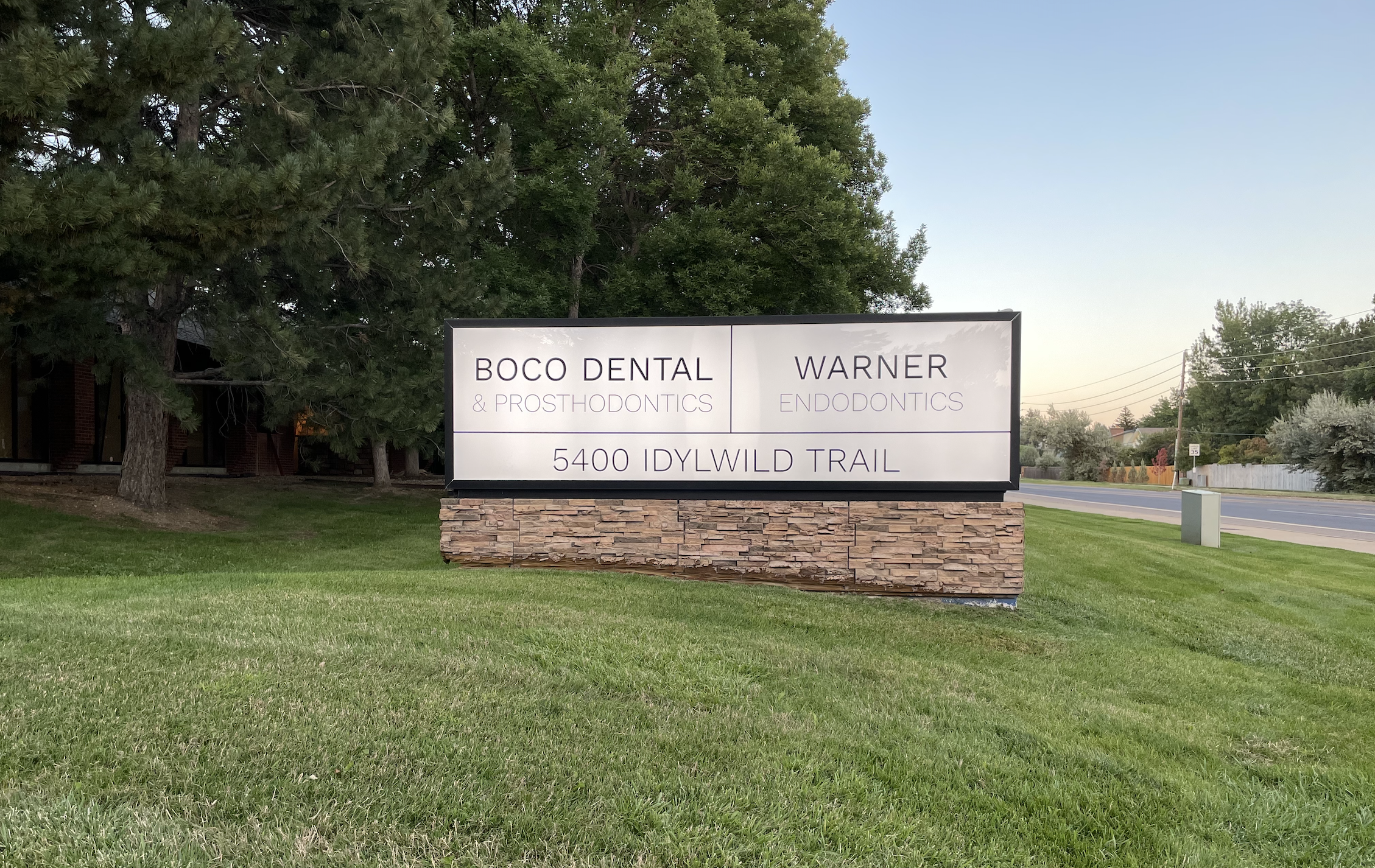
We are located at 5400 Idylwild Tr, Suite C in Boulder (cross street at Lookout Rd).

Comment


   New Office Location Coming in September!

Comment

New Office Location Coming in September!

We are excited to report that the brand new office location will be ready next month. The development of the site is moving along swiftly and we can’t wait to get into our new digs! The office will be state-of-the-art with all of the comforts and conveniences you’d expect. We will be moving 1/2 mile to the west onto the corner of Lookout Road and Idylwild Trail. Come back for more updates.

Comment


   Have you sustained trauma to your tooth?  It does not have to be a major injury to cause lasting damage to your tooth or teeth.  It is advisable to have the tooth or affected area checked out as soon as possible following an injury.  Type

1 Comment

Have you sustained trauma to your tooth?

It does not have to be a major injury to cause lasting damage to your tooth or teeth. It is advisable to have the tooth or affected area checked out as soon as possible following an injury.

Types of Tooth Trauma

  • Crown Fracture - may involve only tooth structure or it may expose the pulp (nerve) of the tooth.

  • Root Fracture - complete or partial fracture within the root of the tooth.

  • Concussion - think of a bruise on the tooth. There is no displacement or mobility but there is pain upon touching the tooth

  • Subluxation - injury that results in mobility of the tooth without displacement. The tooth may be painful to touch and will also have some wiggle to it

  • Luxation - injury resulting in displacement of the tooth. The displacement can be lateral, intrusive, or extrusive.

  • Avulsion - complete loss of the tooth (knocked out).

An endodontist may not always be the first person to manage the emergency treatment of the trauma (i.e. replanting, repositioning, or splinting a tooth), but they should be consulted ASAP after an injury. Timely management of dental trauma can help save a tooth and avoid unnecessary damage. Consultation with an endodontist should be done within 1 week of the injury.

1 Comment

Comment

23A39B03-B872-4523-9E89-DD761145CCF7.JPG

Tooth Savers

If your tooth has been recommended for extraction, have you consulted with an endodontist to determine if it could be saved?

Comment

Board-Certified

3 Comments

Board-Certified

In the fall of 2016, Dr. Warner successfully completed the board certification process and was named a Diplomate of the American Board of Endodontics.  Only about 1 in 5 endodontists nationally are board-certified.  In New York City, the percentage of boarded endodontists is even lower.  Achieving Diplomate status requires dedication to the profession of endodontics, excellence in patient care, a high moral character, and the pursuit of continuing education in the field.  

3 Comments

Is cold sensitivity after a filling an indication for a root canal?

1 Comment

Is cold sensitivity after a filling an indication for a root canal?

If you are not informed about what to expect following a filling, you may be alarmed if your tooth suddenly becomes symptomatic after a filling.  Many times patients complain that they had no pain before a procedure and their sensitivity to cold began immediately after the filling.  It is not uncommon to have sensitivity to cold after a filling, and it can be completely normal.  When a cavity is removed from a tooth, the pulp tissue (nerve) can become temporarily inflamed.  When the pulp becomes inflamed, it can respond to cold stimuli more rapidly and with hypersensitivity.  As long as the sensation is short lasting and only when provoked, you should expect the symptoms to subside within a few days.  The inflammation of the pulp in this case is reversible and no further treatment is required.

If you are having prolonged hypersensitivity, such as pain to cold that lingers for 30-60 seconds, or the pain is spontaneous without provocation, the pulp may be irreversibly inflamed.  A pulp with irreversible inflammation is incapable of healing and requires root canal therapy.

1 Comment

Not all studies are created equal

2 Comments

Not all studies are created equal

Scientific research is the foundation for which dental and medical treatments are based. Evidence-based dentistry is the practice of performing treatment shown by the literature to be of a particular benefit to the patient.  Providing dental treatments based on anecdotal evidence not supported by scientific research can be ineffective and dangerous.

When reading scientific research, it is important to not take anything at face value.  The type and design of the study has huge implications on the validity of the conclusions presented.  Well-designed randomized clinical trials have the highest level of evidence due to their strict control of variables.  Animal studies have a lower level of evidence due to their questionable application to human beings.

One study design that seems to present very convincing conclusions, but must be carefully considered is the cross-sectional study.  These studies are most often surveys asking people a series of questions.  They can be used to establish a correlation between two or more factors, such as eye color and whether or not you own a motorcycle.  Perhaps more people with brown eyes own a motorcycle than people with green eyes.  Although a trend may be seen in the data, it does not mean that there is a causative relationship between the factors.  

The findings of these studies are passed off as facts and widely distributed throughout the media and internet.  Without well-designed research examining these possible relationships, no causation can be established.  Accepting survey data as fact can lead to potential harmful situations, such as when a patient declines certain dental medical treatment in lieu of unproven remedies.

John Oliver makes some good points:

John Oliver discusses how and why media outlets so often report untrue or incomplete information as science. 

2 Comments